Some anime phrases don’t just stay in anime. They escape into real life — printed on t-shirts, used in political memes, shouted at conventions, referenced in Hollywood films. And for Japanese learners, these iconic lines are a gold mine.
I’m a native Japanese speaker, and I’ve spent years watching American anime fans use these phrases without knowing what they actually mean in Japanese. Today I’m fixing that.
Here are 5 anime phrases that genuinely broke the internet — and exactly what they teach you about the Japanese language.
1. “It’s Over 9000!” — Dragon Ball Z
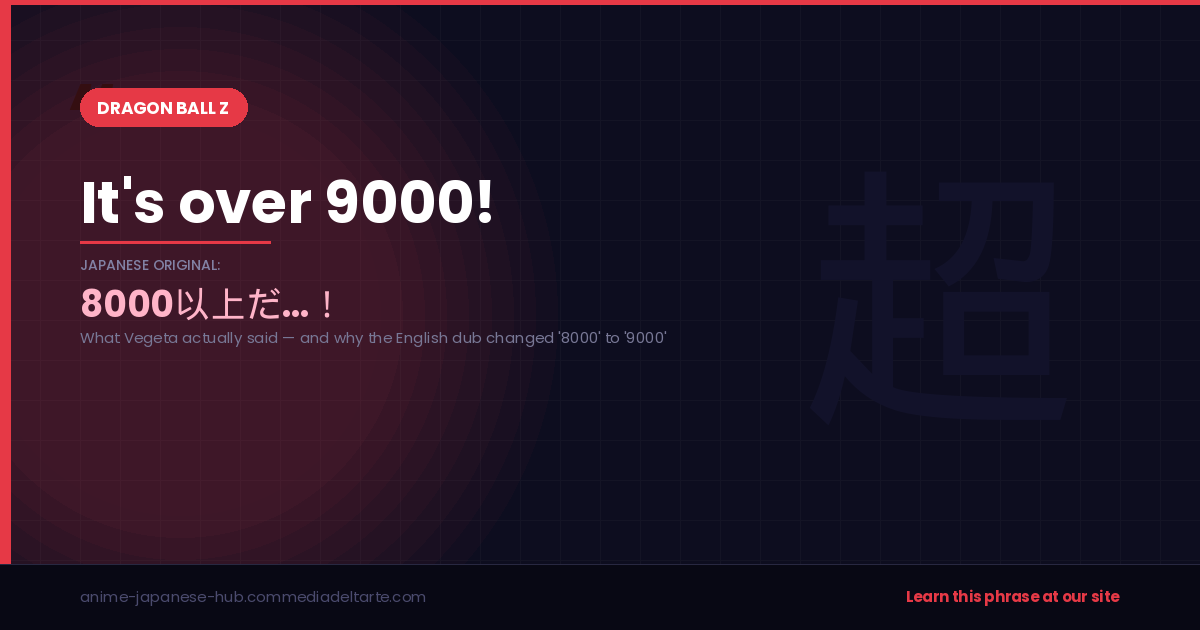
The phrase: “It’s over 9000!” What Vegeta actually says in Japanese: 「8000以上だ…!」(Hassen ijou da…!)
The translation story
This is one of the most famous mistranslations in anime history — and it teaches us something fascinating about how Japanese gets localized.
In the original Japanese, Vegeta reads Goku’s power level as 「8000以上」 — “over 8,000.” But when 4Kids dubbed the English version for American TV in 1996, the voice director changed it to 9,000 because the phrase “nine thousand” fit better in Vegeta’s mouth during that moment on screen (this is called lip-sync dubbing).
The rest, as they say, is internet history.
What the Japanese teaches you
〜以上 (ijou) — “more than / over / exceeding”
This is an extremely useful expression in everyday Japanese:
- 「100円以上」= “100 yen or more”
- 「18歳以上」= “18 years old or older”
- 「それ以上」= “beyond that / more than that”
〜だ (da) — the plain form of “is”
「8000以上だ」uses the plain-form copula だ, which is casual/masculine speech. In formal Japanese it would be 「8000以上です」(Hassen ijou desu). The plain form is what you’ll hear constantly in anime because characters speak naturally, not formally.
The number: 「八千」(hassen) = 8,000. Japanese numbers are logical: 八 (8) + 千 (thousand) = 8,000. Once you know the base numbers (一、二、三…) and 千 (1,000) and 万 (10,000), you can build any large number.
2. “That’s My Ninja Way!” — Naruto
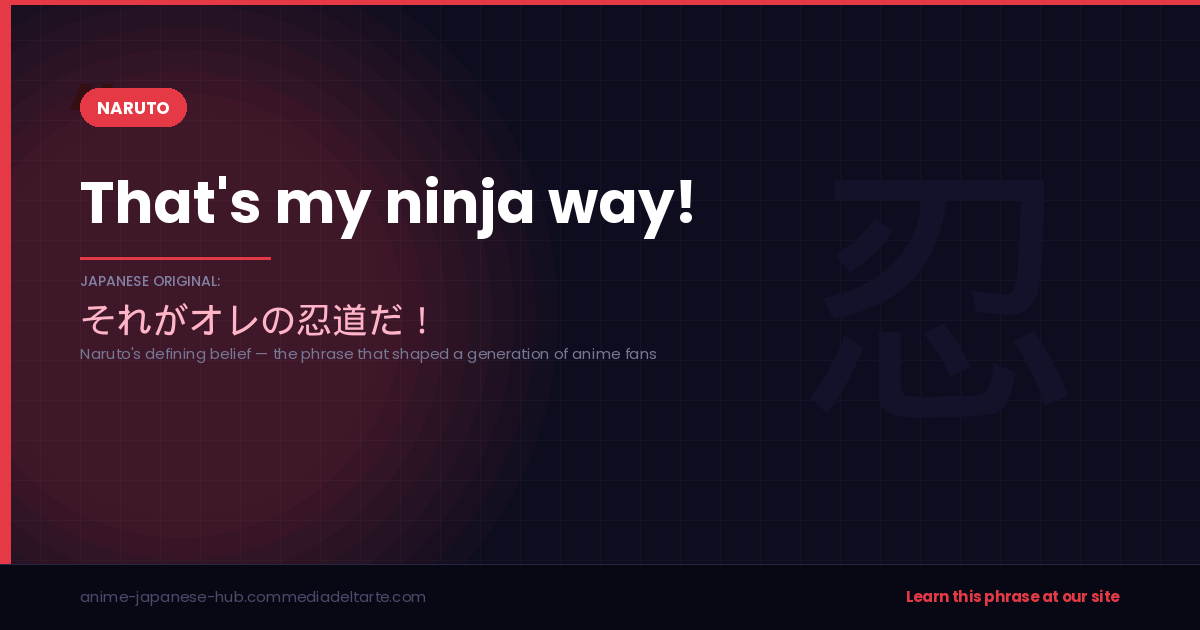
The phrase: “That’s my ninja way!” Japanese original: 「それがオレの忍道だ!」(Sore ga ore no nindou da!)
Why this phrase matters culturally
This line is Naruto’s whole thing. He repeats it whenever he’s pushed to his limits and needs to prove himself. The concept of a personal code you refuse to abandon — a 忍道 (nindou), literally “ninja way/path” — resonates universally, which is why it became so iconic.
In the 2019 “Storm Area 51” meme event, thousands of people ran in the famous Naruto pose (nindou in spirit, if not in letter). The phrase was everywhere.
What the Japanese teaches you
それが (sore ga) — “that is / that’s”
それ means “that” (referring to something the other person just mentioned or what was just established). が is the subject marker particle — one of the most important particles in Japanese. Compare:
- 「それはすごい」= “That is amazing” (は = topic marker, neutral statement)
- 「それがオレの忍道だ」= “That is my ninja way” (が = emphasis on that specific thing)
The が here creates emphasis — it’s not just any ninja way, it’s that thing we’ve been discussing. This が vs は distinction trips up most learners, but anime dialogue is perfect for training your ear to hear the difference.
オレ (ore) — informal first-person “I” (masculine)
Standard Japanese has multiple words for “I”:
- 私 (watashi) = polite/neutral
- 僕 (boku) = casual, used by males and boys
- オレ (ore) = rough/masculine, sounds tough or confident
Naruto uses オレ to show his personality. It’s informal and bold. You’ll hear this constantly in action anime. Note: don’t use it in business contexts!
〜の忍道 (no nindou) — “my ninja way”
の is the possessive particle: オレの = “my,” 先生の = “teacher’s,” 日本の = “Japan’s.” It’s used far more frequently than English possessives and is one of the first particles you should master.
3. “See You Space Cowboy…” — Cowboy Bebop
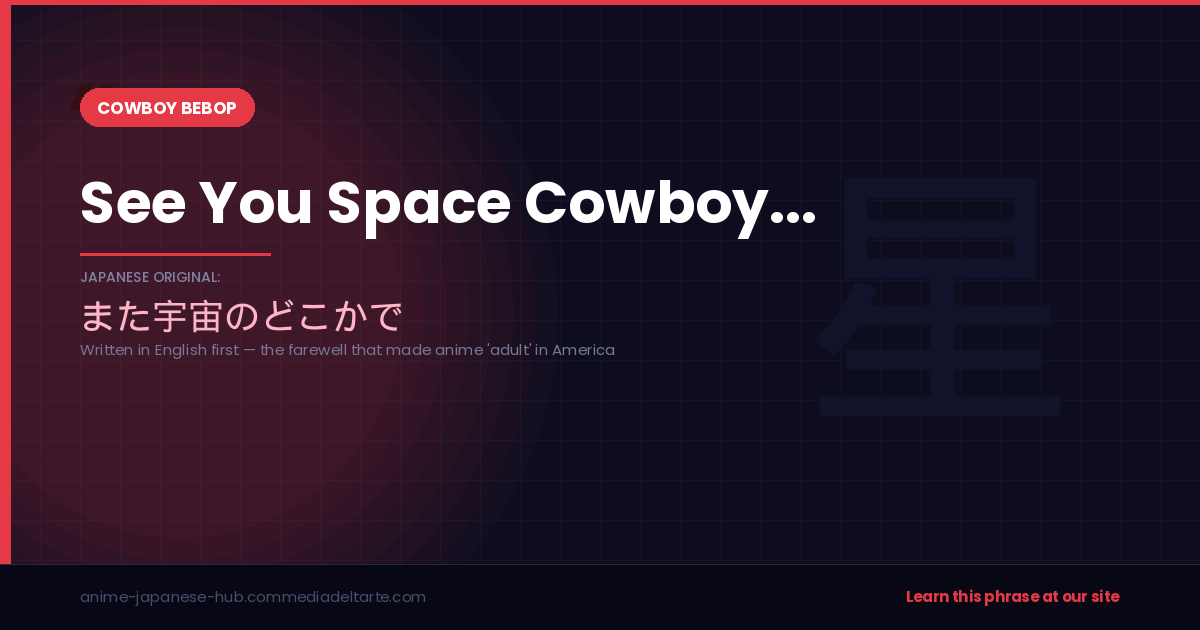
The phrase: “See You Space Cowboy…” Japanese original: 「また宇宙のどこかで」(Mata uchuu no dokoka de)
Why this phrase is unique
Here’s the twist: “See You Space Cowboy…” was written in English first. The Japanese production team composed this phrase directly in English and displayed it on screen that way, even in the original Japanese broadcast.
This is rare in anime — and it explains why the phrase landed so perfectly with American audiences. There was no translation gap. The emotional weight came through directly.
However, the Japanese spirit of the phrase is captured in また宇宙のどこかで — “Again, somewhere in space.” The nuance is slightly different: the English implies a definite future meeting (“see you”), while the Japanese is more open and wistful (“somewhere, again”).
This is Cowboy Bebop in one phrase: stylish, melancholy, and deliberately ambiguous.
What the Japanese teaches you
また (mata) — “again / once more”
One of the most useful words in daily Japanese:
- 「またね」= “See you later” (casual farewell)
- 「また来てください」= “Please come again”
- 「また会いましょう」= “Let’s meet again”
宇宙 (uchuu) — “universe / outer space / cosmos”
Just a good vocabulary word. Bonus: 宇 means “eave/house” and 宙 means “mid-air” — together they evoke something infinitely vast above you.
〜のどこかで (no dokoka de) — “somewhere in ~”
どこか = “somewhere” (indefinite place) で = location particle (where an action happens) の connects a modifier to どこか
So 「宇宙のどこかで」= “somewhere in (the space of) the universe.” The の here turns 宇宙 into a modifier for どこか. This pattern shows up constantly:
- 「日本のどこかで」= “somewhere in Japan”
- 「世界のどこかで」= “somewhere in the world”
4. “Dedicate Your Hearts!” — Attack on Titan
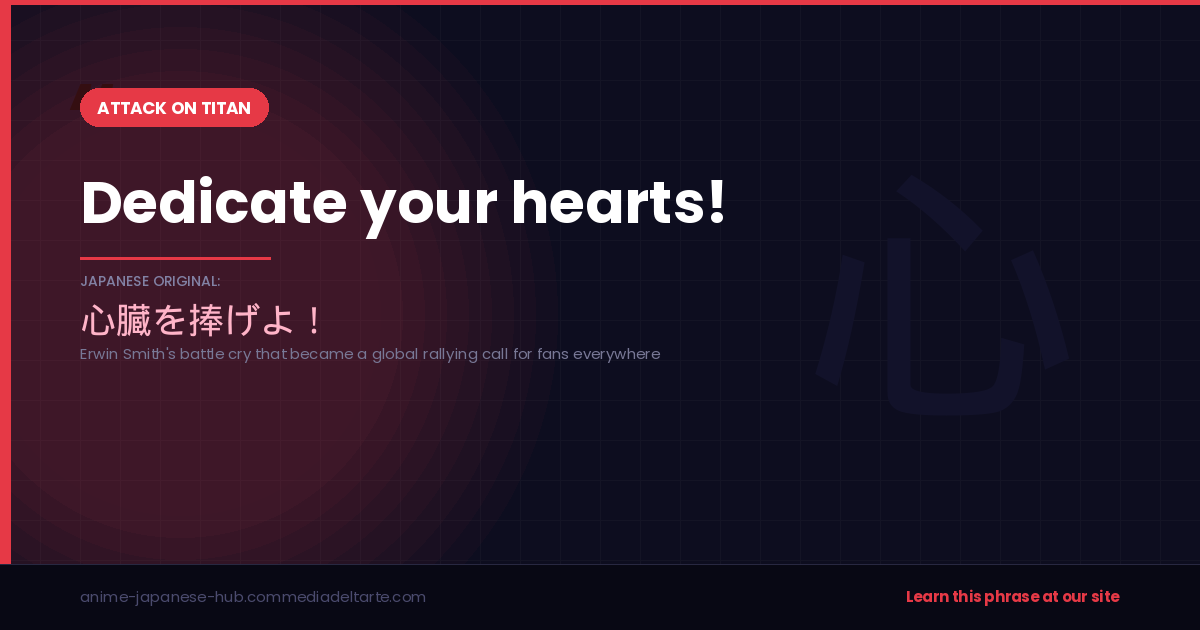
The phrase: “Dedicate your hearts!” Japanese original: 「心臓を捧げよ!」(Shinzou wo sasageyo!)
Why this phrase became a cultural moment
Attack on Titan arrived at the perfect time — the early days of Crunchyroll’s streaming dominance, when anime fans were watching episodes the same week as Japan for the first time. Erwin Smith’s speech before the charge against the Beast Titan is considered one of the greatest moments in anime.
The English dub by J. Michael Tatum delivers the line with such raw intensity that clips went viral across YouTube and TikTok. “Dedicate your hearts!” became the internet’s go-to expression for committing fully to something difficult.
What the Japanese teaches you
心臓 (shinzou) — “heart” (the physical organ)
Note: 心 (kokoro) = heart in the emotional/spiritual sense (“warm-hearted,” “soul”). 心臓 (shinzou) = the physical beating heart. The distinction matters — 心臓を捧げよ is visceral. It means literally giving your beating heart, not just your feelings.
〜を (wo) — the direct object marker particle
を marks what the verb acts on:
- 「心臓を捧げよ」= “Dedicate your hearts” (hearts = direct object of dedicate)
- 「日本語を勉強する」= “Study Japanese”
- 「映画を見る」= “Watch a movie”
This is one of the most essential particles in Japanese. Every sentence with a transitive verb uses を.
〜よ (yo) — imperative/command ending
「捧げよ」is the imperative form of 捧げる (sasageru) = “to offer / dedicate.” The よ suffix on a plain verb creates a strong command — it’s archaic and forceful, perfect for a military battle cry. Modern Japanese uses softer forms like 「捧げてください」in everyday speech.
5. “I Am Here!” — My Hero Academia
The phrase: “I am here!” (or “Have no fear! Why? Because I am here!”) Japanese original: 「私が来た!」(Watashi ga kita!)
The translation that got better in English
This is a fascinating case where the English translation arguably improves on the original.
In Japanese, 「私が来た!」literally means “I have arrived!” or “I came!” — it’s a statement of arrival. Technically, 来た (kita) is the past tense of 来る (kuru) = “to come.”
But the English translation “I am here!” changes the nuance: instead of announcing arrival, it declares existence and presence. “I am HERE.” Standing. Protecting. Permanent.
For All Might — a hero whose presence alone is meant to make people feel safe — “I am here!” is more emotionally accurate, even if it’s not a literal translation.
What the Japanese teaches you
私が来た (watashi ga kita) unpacks into three lessons:
私 (watashi) — “I” (polite/neutral)
All Might uses 私 (watashi) rather than オレ (ore) (Naruto’s choice) or 俺 (ore). This gives him a formal, dignified tone even while being exuberant. The choice of first-person pronoun tells you so much about a character in Japanese.
が (ga) — subject marker with emphasis
Again, が appears! 「私が来た!」— it’s not just someone who has arrived. I specifically am here. The が creates that “Symbol of Peace has arrived” emphasis. Compare to は:
- 「私は来た」= “I (for one) have come” (topic, matter-of-fact)
- 「私が来た」= “I have come!” (emphasis — it’s specifically me, the one you needed)
来た (kita) — past tense of 来る (kuru) “to come”
来る is one of only two irregular verbs in Japanese (する suru = “to do” is the other). It conjugates uniquely:
- 来る (kuru) = present/future “will come”
- 来た (kita) = past “came / has arrived”
- 来ない (konai) = negative “doesn’t come”
- 来て (kite) = te-form “come and…”
The Big Lesson: Why Anime Is a Real Learning Tool
These five phrases aren’t just fun trivia. They’re windows into how Japanese actually works — particles, verb forms, pronoun choices, and the nuance that changes meaning across translations.
That said, anime alone won’t get you to fluency. You need structure. The grammar in action anime is often hyper-formal, archaic, or intentionally dramatic. “Dedicate your hearts!” is not how you order coffee in Tokyo.
The most effective approach: use anime to build listening comprehension and emotional connection to Japanese — then study the grammar and vocabulary in a structured way that makes the anime start to click.
That’s exactly what JapanesePod101 is designed for. Their audio lessons are taught by native speakers, cover anime-relevant vocabulary and JLPT levels, and you can start for free.
FAQ
Can I actually learn Japanese just by watching anime?
Anime is an excellent *supplement* but not a complete learning system on its own. The vocabulary in anime skews heavily toward dramatic expressions, informal speech, and genre-specific terms. You'll hear a lot of battle cries and emotional speeches but not much practical daily Japanese. Use anime to train your ear and stay motivated — pair it with structured grammar study for real progress.
Is "It's over 9000!" really a mistranslation?
Sort of. The number was intentionally changed (from 8,000 to 9,000) to fit the lip movement of the English dub — this is standard practice in dubbing called "lip-sync matching." The meaning wasn't changed, just the number. Many anime fans don't realize the original line says 8,000 (八千, hassen) in Japanese.
Why do anime characters say "ore" instead of "watashi"?
Japanese has multiple first-person pronouns that signal personality and social context. 私 (watashi) is polite and gender-neutral. 僕 (boku) is casual/boyish. オレ (ore) is rough and masculine — it signals confidence, toughness, or informality. Anime writers choose these deliberately. Naruto says "ore" to show he's direct and bold. All Might says "watashi" to show dignity and authority.
What's the best way to use these phrases to actually study Japanese?
Pick one phrase and dig into it completely: look up every particle (は, が, の, を), understand the verb form (plain, past, imperative), and notice the register (formal vs informal). Then find that same grammatical structure in three other contexts. JapanesePod101 has lessons specifically built around this kind of contextual learning — you can start free and explore their anime-focused vocabulary series.
Final Verdict
The phrases that define anime culture — “It’s over 9000!”, “That’s my ninja way!”, “See You Space Cowboy…”, “Dedicate your hearts!”, “I am here!” — aren’t just memes. They’re real Japanese grammar in action.
Every one of them taught us something:
- DBZ: How 以上 works and why plain form だ sounds natural
- Naruto: The critical difference between が and は
- Cowboy Bebop: How どこかで builds location expressions
- Attack on Titan: Why を marks direct objects and what imperatives look like
- My Hero Academia: How first-person pronouns shape character and why 来た is irregular
Now go find the phrases in your favorite anime that made you want to learn Japanese in the first place. Dig into them the same way. The language is hiding in plain sight inside stories you already love.